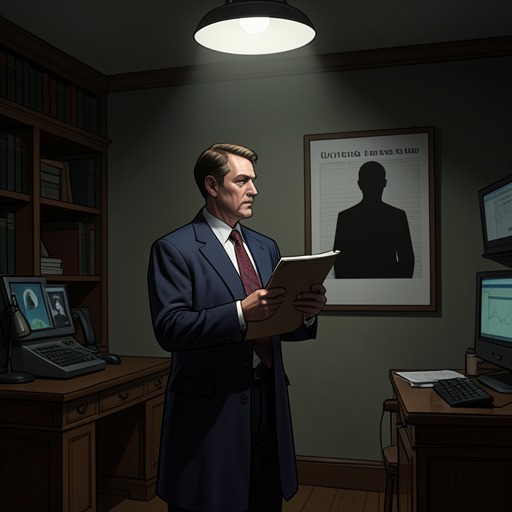
Rusty Sabich facing a murder charge and awaiting trial
Presumed InnocentRusty Sabich’s period as an accused man begins with a formal murder indictment and quickly becomes a contest over time: the prosecution’s evidence appears durable, while delay threatens to deepen the pressure on him and strengthen the case against him. He pleads not guilty, rejects the usual pause for pretrial bargaining, and asks for an immediate trial. The court grants an accelerated schedule, but the charge remains unresolved as he waits for the case to be heard.
The Indictment and Its Immediate Weight
The grand jury’s June-session indictment charges Rusty with first-degree murder in connection with Carolyn Polhemus’s death. By July 14, three weeks after the indictment, he is preparing to appear before Chief Superior Court Judge Edgar Mumphrey for arraignment. The prosecution has supplied the defense with a box of evidence and witness materials under the state’s criminal discovery requirements. The familiar case label on the box makes the accusation tangible: it is no longer only a public suspicion or a possibility he can set aside, but a formal proceeding supported by an organized file.
Rusty’s response to the indictment is not simple disbelief. He recalls that, after months of press leaks and rumor, he had said an indictment might bring relief by ending the uncertainty. When the charges reached him, however, the realization that he was formally accused overwhelmed that expectation. He experiences the news as a physical and emotional shock, then tries to remain composed because he sees composure as the only available response. The legal process gives shape to the crisis without making it easier to bear.
The Case as Rusty Assesses It
From the discovery materials, Rusty understands the prosecution’s case, assembled under Nico Delia Guardia, as straightforward in structure but circumstantial in character. No listed witness claims to have seen him kill Carolyn, and the materials do not establish a confession. Instead, the case depends on several kinds of physical and testimonial evidence that the prosecution can arrange into a connected account of opportunity and presence.
Among the evidence is a glass bearing two of Rusty’s fingerprints, compared with prints he had provided years earlier in his work as a deputy prosecutor. The prosecution also plans to rely on telephone records showing a call from his home to Carolyn’s shortly before her death, and on forensic biological evidence reported from Carolyn’s body. Fibers found on her clothing and elsewhere in the apartment are said to match the carpet in Rusty’s home. These items do not amount to an eyewitness account; their force lies in their accumulation and in the inferences the prosecution will ask the court to draw from them.
The witness list adds different forms of support and uncertainty. Mrs. Krapotnik identifies Rusty as someone she saw in Carolyn’s building, but is unsure whether he was the stranger she observed on the night of the murder. A maid from Nearing may place him on a bus near the relevant time, though Rusty describes her statement as cryptic. Dan Lipranzer is listed in connection with Rusty’s instruction not to subpoena his home telephone records. Other listed witnesses include Raymond Horgan, Tommy Molto, Rusty’s secretary Eugenia Martinez, and Dr. Robinson, the psychiatrist he consulted on several occasions; scientific experts, including Painless Kumagai, are also expected to testify. The materials thus combine uncertain identification and witness accounts with forensic and documentary evidence.
Arraignment and the Demand for Speed
At arraignment, Rusty’s lawyers, Alejandro Stern, P.C., formally appear on his behalf and waive the reading of the indictment. Through counsel, he enters a plea of not guilty. Bail is set by agreement as a $50,000 signature bond. The ordinary next step would be a pretrial conference, a session commonly used for plea bargaining and to allow both sides additional time. The defense declines it.
The request for an immediate trial is presented publicly as a response to the gravity and alleged falsity of the charge and the damage done to Rusty’s reputation as a public servant and attorney. It is also a tactical decision. Sandy Stern has stressed that a quick resolution could shorten the strain on Rusty, but Rusty recognizes the prosecution’s opposing advantage: the fingerprints will remain identifiable and the telephone records will not disappear. With time, the prosecution might also find another witness or learn what happened to the murder weapon. In his view, delay risks making an already substantial case stronger rather than allowing it to fade.
An Accelerated Schedule, an Unresolved Case
The request catches Nico Delia Guardia and Tommy Molto by surprise. Judge Mumphrey accepts the waiver of a pretrial conference and orders that a trial date be drawn immediately. The procedure reflects a reform Rusty had once proposed after a scandal in the clerk’s office: a judge’s name is selected publicly from plaques spun inside a closed cage. The mechanism was devised to make assignment visibly random, and Rusty remembers that the proposal was formally advanced in Raymond Horgan’s name. The public draw sets the machinery of trial in motion, though it does not settle the question of guilt.
A further scheduling decision brings the trial closer than the defense had anticipated. Judge Larren Lyttle says he will be free for twelve trial days beginning August 18, after another case pleads. Rusty’s lawyers accept the date without hesitation, although they had expected nothing sooner than the fall. The compressed timetable makes the demand for speed concrete: preparation must proceed on a short schedule, and the trial is no longer a distant prospect.
Waiting Under Accusation
While these legal decisions take shape, Rusty describes himself as often remote and emotionally suspended, alternating between efforts to understand how events have reached this point and a refusal to follow his speculation into panic and rage. He is preoccupied with the eventual result and with the effect the accusation may have on his son, Nathaniel Sabich. His fear is not limited to the possibility of conviction; he also worries about the shame and family disruption that the case could impose before a verdict is reached.
The state is therefore defined by a sharp mismatch between legal certainty and factual uncertainty. Rusty has been indicted, arraigned, and bound over for a rapidly approaching trial, but the evidence he has reviewed remains circumstantial, and the decisive judgment has not yet occurred. His account places the scheduled court proceeding beside the private cost of waiting: public accusation gives the case its official form, while dread, concern for his son, and occasional unaccountable hope mark the unsettled life inside it.